
Complete
Project Objectives
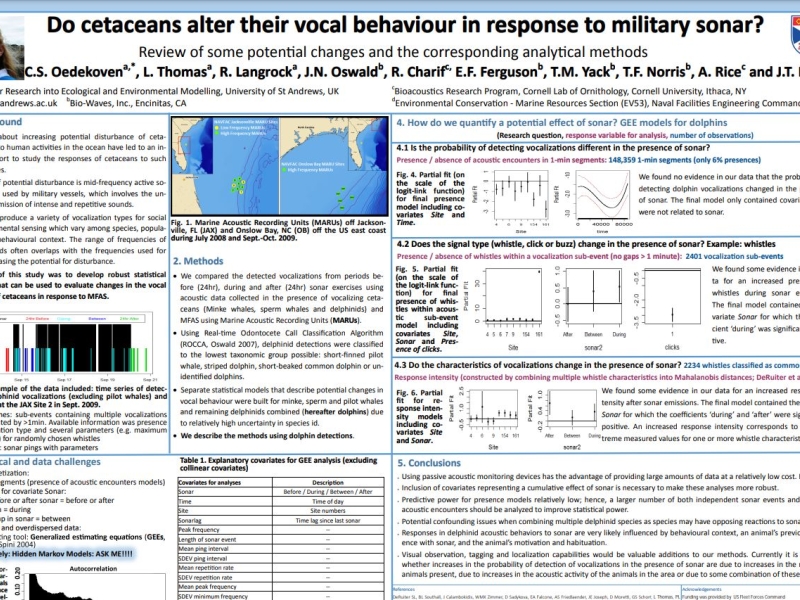
Develop analytic methods to evaluate the vocal response of odontocetes and mysticetes to sonar from navy training activities
Current
Project Objectives
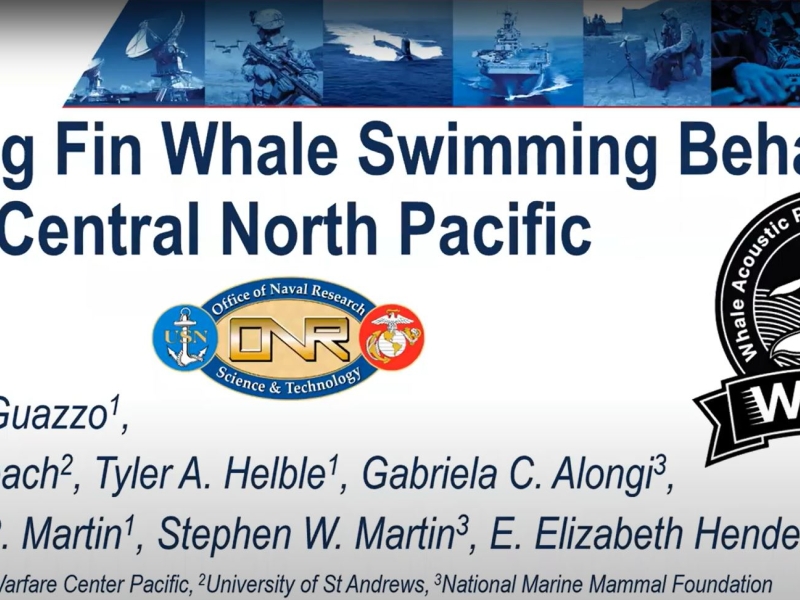
Assess behavioral response of beaked and pilot whales to mid-frequency tactical sonar
Complete
Project Objectives
Assess occurrence, habitat associations, and density of marine mammals and sea turtles in key areas of Navy range complexes
Complete
Project Objectives
Obtain data to characterize the potential exposure of marine mammals and ESA-listed marine species to Navy training and testing activities, evaluate the effectiveness of mitigation measuresNo related blog posts to display
More details
Collapse details
Date Published:
Filesize:
- July 7, 2026
The Rice’s whale (Balaenoptera ricei; formerly Gulf of Mexico Bryde's whale) is estimated to have a population size of 51 individuals in U.S. waters (Garrison et al., 2020), and was listed as endangered under the ESA in 2019 (84 Federal Register 15446, 87 Federal Register 8981). The majority of modern sightings occur within waters between the 100 and 400 meter isobaths within an area near the De Soto Canyon off northwestern Florida (Rosel et al., 2021; Soldevilla et al., 2017), an area defined as the Rice’s whale core distribution area (Rosel & Garrison, 2022). Occurrence patterns from long-term passive acoustic monitoring (PAM) over the 2010–2024 period and from summer and fall visual surveys during 2018 and 2019 indicate that the whales are found year-round within the core distribution area, but also suggest there may be seasonal movements throughout, and potentially out of, this area. High densities of anthropogenic activities occur throughout the Gulf of America (formerly Gulf of Mexico, hereafter GOA), including oil and gas exploration and extraction, fisheries, shipping, and military activities. Many of these activities, including U.S. Navy readiness activities, and Eglin Air Force Base activities, overlap with the whales’ core distribution area. Understanding seasonal distribution and density of Rice’s whales throughout this area will improve understanding of potential impact of human activities, improve the accuracy and precision of impact assessments, and assist in developing effective mitigation measures as needed. To improve management of human-based activities in the core distribution area of these endangered whales, the SEFSC deployed a sparse array of 17 PAM units concurrent with one long-term High-frequency Acoustic Recording Package (HARP) from May 2021 to March 2023. The PAM moorings were deployed in two lines of nine units each to nearly completely cover the core distribution area over a nearly 2-year period to improve understanding of seasonal and interannual distribution, movement patterns, and habitat use. The moorings used SoundTrap ST500 or ST600 STDs, calibrated long-term recorders capable of continuously recording underwater sound in the 20 Hertz to 48 kHz frequency range, including Rice’s whale calls and ambient noise, for up to 6 months. Additionally, the study leveraged a long-term HARP deployed by the SEFSC, Scripps Institution of Oceanography, and collaborators, at the De Soto Canyon site in the Rice’s whale core distribution area over the August 2020 to July 2025 period. At this site, they have continuously recorded ambient noise and other acoustic events in the 10 Hertz to 100 kHz frequency range since 2010 to monitor the impacts of the Deepwater Horizon oil spill and subsequent restoration activities on cetaceans. Analyses from the combined DC HARP and sparse array of SoundTrap deployments over the 2021-2023 period suggested Rice’s whale detections occurred at all PAM stations throughout the entire year, with detections occurring more commonly on the inshore line compared to the offshore line, and suggested call detections increased to the south in winter and to the north in summer. Additional data collection was recommended to determine whether these patterns were consistent over longer periods, as needed to understand seasonal distribution and density of Rice’s whales. To meet this need, a new 3-year project is being conducted from June 2025 to June 2028 that includes redeploying the PAM array for at least one more year, and conducting analyses of Rice’s whale spatiotemporal occurrence across the new (2025-2026) and historic (2021-2023) datasets. The project objectives include 1) characterizing spatiotemporal distribution of calling Rice’s whales throughout the CDA over three years to understand interannual variation in year-round occurrence patterns; 2) evaluating whether intra-annual habitat use patterns represent consistent seasonal cycles over time; and 3) evaluating longer-term trends in occurrence of calling Rice’s whales as needed for monitoring population recovery. Results from 2021-2023 will be combined with the current effort to yield the three full years of broad coverage passive acoustic data collection. The project is off to a successful start. In June 2025, 17 SoundTrap ST600 STD recorders were deployed at the same study sites from the 2021-2023 period, along with the De Soto Canyon HARP. In January 2026, all 17 SoundTrap recorders were successfully retrieved. Upon initial inspection, acoustic recordings from each instrument were of high quality, yielding a total of 3,524 instrument-days of recording effort. The instruments recorded for a median of 6.9 months each, with most recordings ending in late December or early January. All 17 SoundTrap recorders were serviced and redeployed for another 6-month deployment. They will be retrieved, along with the HARP, in June 2026. Data analyses, including Rice’s whale call detection, localization, and call density estimation will begin in fall 2026.
- 1,348.75 KB
More details
Collapse details
Date Published:
Filesize:
- January 1, 2024
The NOAA’s Southeast Fisheries Science Center (SEFSC) and Scripps Institution of Oceanography (Scripps) have been collaboratively deploying long-term passive acoustic monitoring stations throughout the Gulf of Mexico (GOM) since 2010 to monitor the impacts of the Deepwater Horizon oil spill and subsequent restoration activities on cetaceans. High-frequency Acoustic Recording Packages (HARPs) deployed at the De Soto Canyon (DC) site in the Rice’s whale core distribution area have been continuously recording ambient noise and other acoustic events in the 10 Hz to 100 kHz frequency range. During 2019- 2021, SEFSC conducted analyses of eight years of near-continuous DC HARP recordings (2010-2018) to understand Rice’s whale seasonal and interannual occurrence patterns at this site. During the first phase of this project, SEFSC developed automated Rice’s whale call detectors and analyzed eight years of historic data from the DC HARP in the core distribution area to establish complete occurrence time-series for understanding seasonal and interannual trends and for future habitat modeling and density estimation. Rice’s whale call detections occurred throughout the year at this site with increased call detection rates during summer and fall compared to winter and spring.
- 14,630.13 KB
More details
Collapse details
Date Published:
Filesize:
- January 1, 2023
The NOAA’s Southeast Fisheries Science Center (SEFSC) and Scripps Institution of Oceanography (Scripps) have been collaboratively deploying long-term passive acoustic monitoring stations throughout the Gulf of Mexico (GOM) since 2010 to monitor the impacts of the Deepwater Horizon oil spill and subsequent restoration activities on cetaceans. High-frequency Acoustic Recording Packages (HARPs) deployed at the De Soto Canyon (DC) site in the Rice’s whale core habitat have been continuously recording ambient noise and other acoustic events in the 10 Hz to 100 kHz frequency range. During 2019-2021, SEFSC conducted analyses of eight years of near-continuous DC HARP recordings (2010-2018) to understand Rice’s whale seasonal and interannual occurrence patterns at this site. During the first phase of this project SEFSC developed automated Rice’s whale call detectors and analyzed eight years of historic data from the DC HARP in the core habitat to establish complete occurrence time-series for understanding seasonal and interannual trends and for future habitat modeling and density estimation. Rice’s whale call detections occurred throughout the year at this site with increased call detection rates during summer and fall compared to winter and spring.
- 11,700.79 KB
More details
Collapse details
Date Published:
Filesize:
- January 1, 2022
The Rice’s whale (Balaenoptera ricei; formerly Gulf of Mexico (GOM) Bryde's whale) is estimated to have a population size of 51 individuals in U.S. waters (Garrison et al 2021) and was listed as endangered under the ESA in 2019 (84 FR 15446; 87 FR 8981). The majority of modern sightings occur in waters between the 100 – 400 m water depths in an area near the De Soto Canyon off northwestern Florida (Soldevilla et al. 2017, Rosel et al 2021). This primary distribution area is defined as the Rice’s whale core habitat (Rosel and Garrison, 2022). Occurrence patterns from one year of long-term passive acoustic monitoring and two summer and fall visual surveys during 2018 and 2019 indicate the whales are found year-round within the core habitat, but also suggest there may be seasonal movements throughout, and potentially out of, this area. High densities of anthropogenic activities occur throughout the GOM, including oil and gas exploration and extraction, fisheries, shipping, and military activities; several of these activities overlap with the whales’ primary habitat. Understanding seasonal distribution and density will improve understanding of potential impact of human activities in the core habitat and assist in developing effective mitigation measures as needed.
- 14,027.62 KB
A framework for passive acoustic localization and tracking using a wide-baseline array demonstrated with Rice’s whales (Balaenoptera ricei).
Journal of the Acoustical Society of America. 2026.
159, 802–815 (2026)
More details
Collapse details
Date Published:
- January 28, 2026